




Roof Replacement in Spokane’s South Hill: CertainTeed Landmark in Burnt Sienna
What to expect during a roof replacement in Spokane?
A Spokane roof replacement typically takes one to two days on a home this size. Crews tear off the old roofing to bare deck, replace damaged sheathing, install ice-and-water barrier at the eaves and valleys, add synthetic underlayment, shingles and ridge ventilation, then magnet-sweep the property before a final inspection.
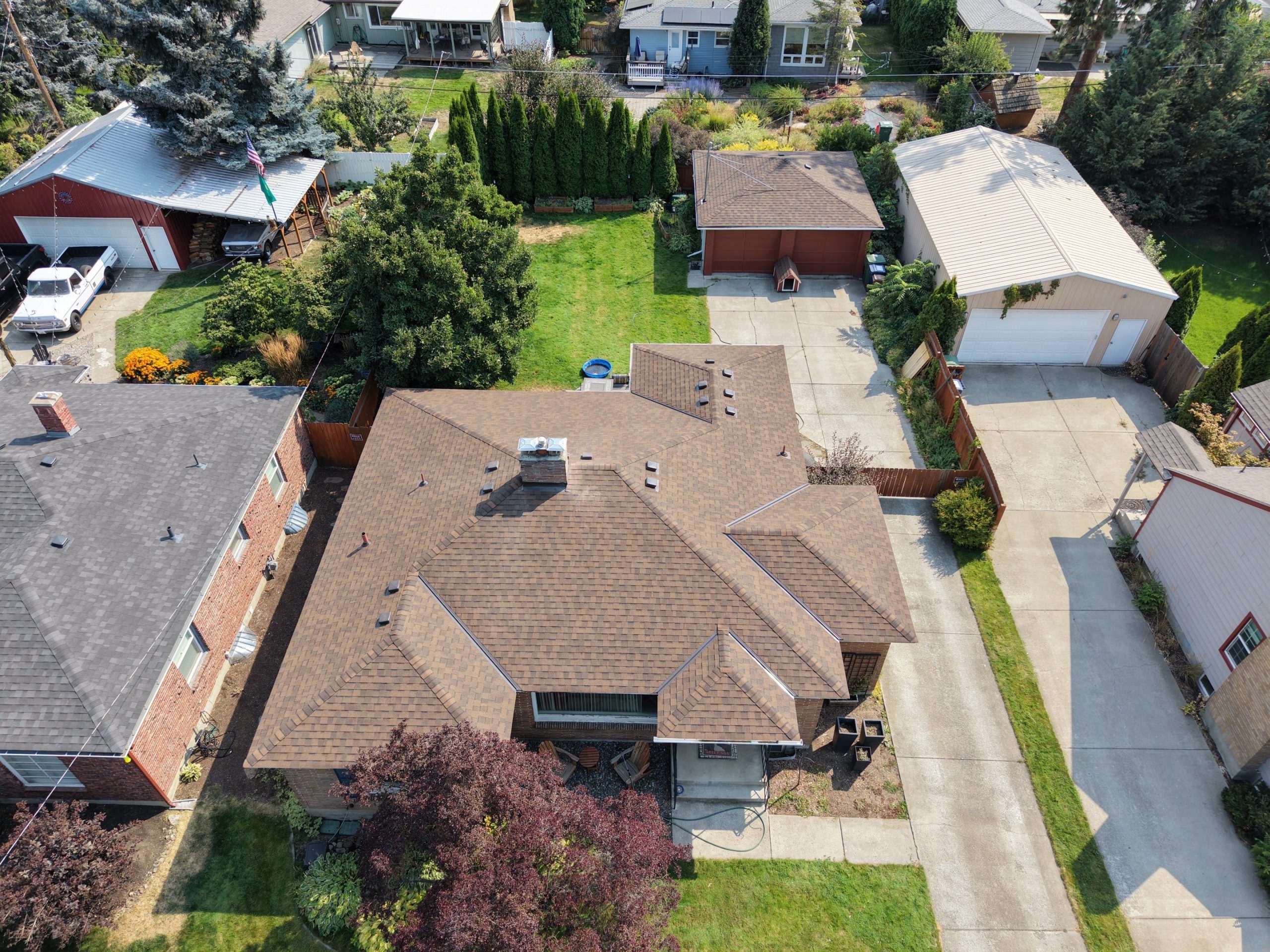
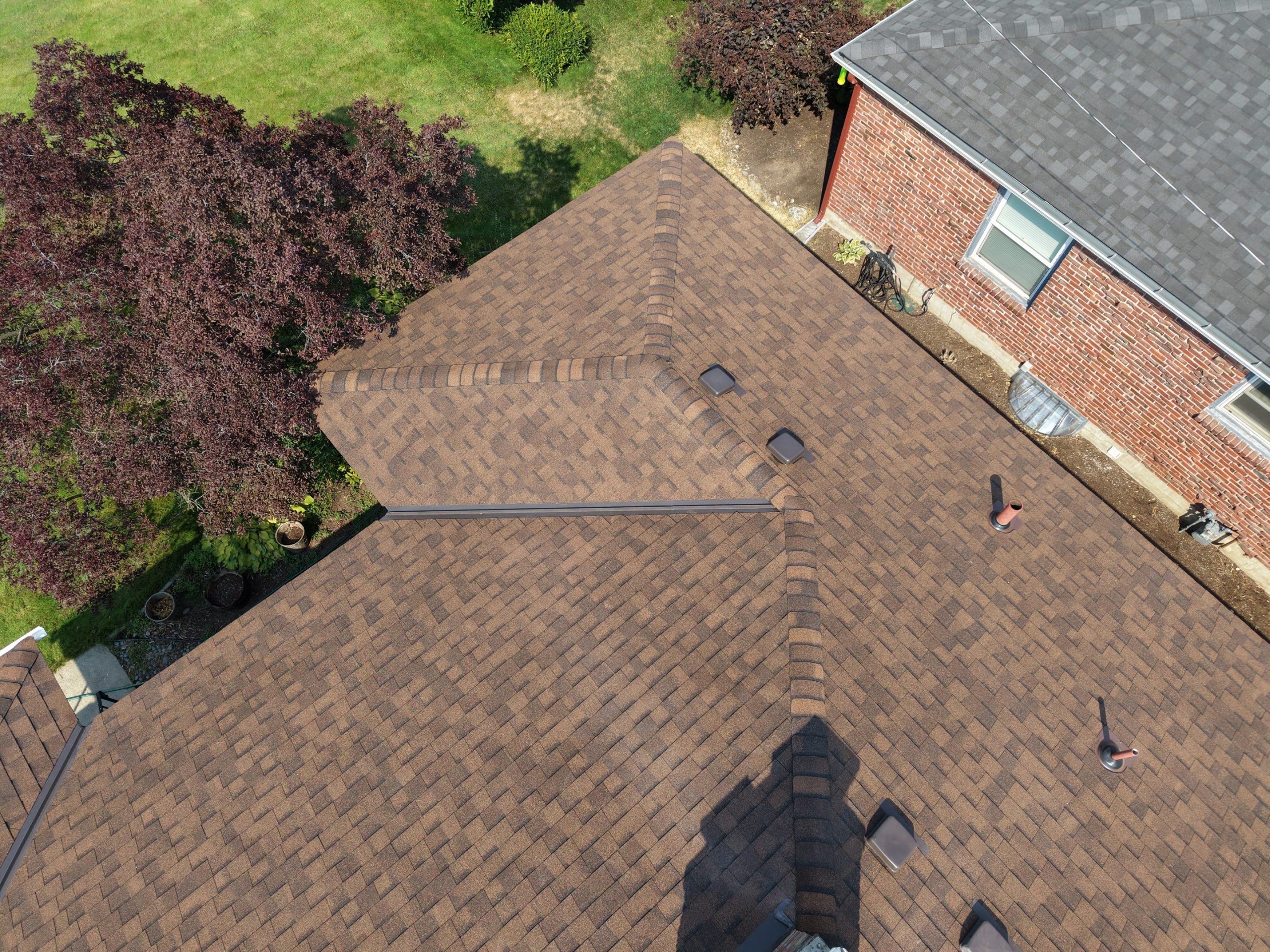
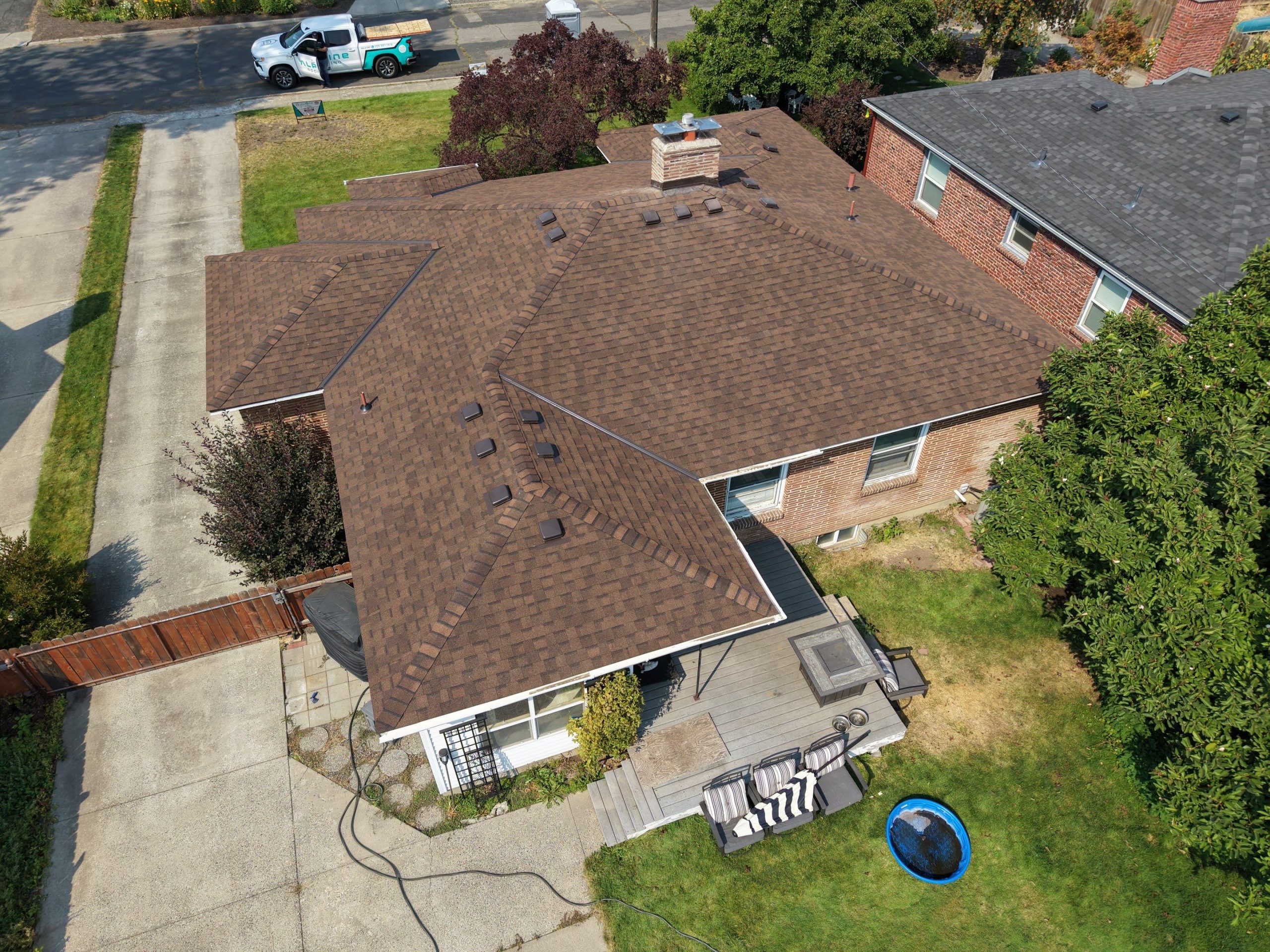
That is the short version. Below is exactly how it played out on a recent job we finished on West 36th Avenue in Spokane’s South Hill neighborhood — a mid-century brick rancher with a complex hip roof, multiple valleys, and a chimney that all had to be flashed and sealed correctly to survive a Spokane winter.
Project snapshot: South Hill roof replacement
| Location | W 36th Ave, South Hill, Spokane, WA 99203 |
| Scope | Full tear-off and roof replacement |
| Roof system | The Denali System by Alpine Roofing |
| Shingle | CertainTeed Landmark® — Burnt Sienna |
| Hip & ridge | CertainTeed Shadow Ridge® |
| Starter course | CertainTeed SwiftStart® |
| Underlayment | CertainTeed RoofRunner™ synthetic |
| Ice & water barrier | Vycor® Select self-adhered membrane |
| Ventilation | Balanced ridge ventilation with intake at the eaves |
| Warranty | 50-year material guarantee, 30-year workmanship guarantee, 5-Star SureStart™ PLUS coverage |
The Denali System: what actually went on this roof
A roof is not a shingle. It is an assembly, and the parts most homeowners never see are the ones that decide whether the roof leaks in February. The Denali System is our full-assembly spec, built entirely from CertainTeed-integrated components so every layer is warranted to work with the layer above and below it.
- Vycor® Select ice-and-water barrier — a self-adhered membrane at the eaves, valleys, and around every penetration. It seals around fastener shanks, so it stays watertight even where it is nailed through.
- CertainTeed RoofRunner™ synthetic underlayment — the secondary water barrier across the rest of the deck. It lies flatter than felt, will not wrinkle when it gets damp, and holds up to foot traffic during a two-day install.
- CertainTeed SwiftStart® starter shingles — a purpose-built starter course along the eaves and rakes. This is what resists wind uplift at the roof edge, which is where nearly every wind failure begins.
- CertainTeed Landmark® shingles in Burnt Sienna — a two-piece laminated architectural shingle with an algae-resistant granule blend. The warm sienna tones were chosen to sit against this home’s red brick without competing with it.
- CertainTeed Shadow Ridge® hip and ridge — dedicated hip and ridge cap shingles rather than cut-up field shingles. On a hip roof like this one, with long hip lines running down all four corners, the difference is visible from the street.
- Balanced ridge ventilation — continuous exhaust at the ridge, paired with intake at the eaves, so air moves through the attic instead of sitting in it.
How Vycor Select and ridge ventilation protect against Spokane ice dams
Spokane averages 45.4 inches of snow a year, based on the National Weather Service 30-year climate normals (1991–2020) recorded at Spokane International Airport. Heavier winters run well past that. But annual snowfall is not really what damages roofs here — the freeze-thaw cycle is.
Why ice dams form on South Hill roofs
Warm air escaping into an under-ventilated attic heats the underside of the roof deck. Snow on the upper roof melts, the meltwater runs down to the cold eave overhang — which sits over open air, not heated living space — and refreezes there. Repeat this for a few weeks and you get a ridge of ice at the eave. Water backs up behind that dam and moves uphill under the shingles, because shingles shed water, they do not seal against it. That is how a roof with no visible damage ends up staining a ceiling.
The two defenses we install
Vycor® Select is the waterproof layer. It is a self-adhering polymer-modified bitumen membrane bonded directly to the deck at the eaves and valleys. Because it seals around nails, standing water trapped behind an ice dam has nowhere to get through. This is the layer that turns an ice dam from a repair bill into a non-event.
Ridge ventilation is the layer that stops the dam from forming. Continuous ridge exhaust paired with eave intake keeps the attic close to outside temperature. A cold deck means the snow on the roof does not melt in the first place. Ventilation also carries out the moisture-laden air that otherwise condenses on the underside of the sheathing all winter — the quiet cause of a lot of premature deck rot in Spokane homes.
What Washington State code requires
This is not optional in Spokane. Under Section R905.1.2 of the Washington State Residential Code, and as stated directly in the City of Spokane’s own roofing permit guide sheet, “an ice barrier that consists of at least 2 layers of underlayment cemented together or of a self-adhering polymer modified bitumen sheet, shall extend from the eave’s edge to a point at least 24 inches inside the exterior wall line.”
Two more things Spokane inspectors check that homeowners should know about: total roofing layers may not exceed two after a new roof is complete, so if a home already has two layers, everything comes off — and the inspector will verify that the attic space is adequately ventilated. Both were satisfied on this project with a full tear-off to bare deck and a balanced ridge ventilation system.
Why South Hill homeowners hire Alpine Roofing
- CertainTeed certified. Our crews are credentialed by the manufacturer whose products we install. That certification is what makes the extended warranty coverage below available in the first place.
- Google Guaranteed. Google independently verifies our license, insurance, and background checks, and backs jobs booked through Local Services. It is third-party accountability, not a self-issued badge.
- 5-Star SureStart™ PLUS coverage. CertainTeed’s top-tier extended protection, which covers workmanship as well as materials — including tear-off and disposal costs if a covered failure occurs.
- 50-year material guarantee. Coverage on the shingles and the integrated components of the Denali System.
- 30-year workmanship guarantee. Our own labor warranty. Most Spokane roofers offer between two and ten years.
- Priority scheduling. Storm damage and active leaks move to the front of the queue. In a Spokane January, waiting three weeks for a tarp is not an acceptable answer.
Frequently asked questions about roof replacement in Spokane
How long does a roof replacement take in Spokane?
Most Spokane homes are torn off and re-roofed in one to two days. Complex hip roofs, steep pitches, multiple layers of existing roofing, or discovered deck rot can extend that to three. Weather is the main variable — we do not leave a deck open overnight if there is precipitation in the forecast.
Is ice and water shield required by code in Spokane?
Yes. Section R905.1.2 of the Washington State Residential Code requires an ice barrier — either two cemented layers of underlayment or a self-adhering polymer-modified bitumen sheet — running from the eave edge to at least 24 inches inside the exterior wall line. The City of Spokane inspects for it on roofing permits.
Can you replace a roof in Spokane during the winter?
Yes, with planning. Asphalt shingles need warmth to activate their self-sealing strip, so cold-weather installs require hand-sealing and careful staging of the tear-off. For an active leak we will always make an emergency repair immediately and schedule the full replacement for stable weather rather than rush a compromised install.
What warranty comes with a new roof from Alpine Roofing?
Every Denali System roof carries a 50-year material guarantee, our own 30-year workmanship guarantee, and 5-Star SureStart™ PLUS coverage from CertainTeed. Because we are CertainTeed certified, that top-tier extended coverage includes labor and disposal costs, not materials alone.
How do I get a new roof estimate in Spokane?
Call or request an inspection online and we will assess your roof, document the deck and ventilation condition with photos, and provide a written, itemized estimate. There is no charge and no obligation. If your roof has storm damage, we will document it in the format your insurance carrier needs.
Get a new roof estimate in Spokane
If your roof is approaching twenty years, if you saw icicles hanging off the eaves last winter, or if you have found granules collecting in the gutters, it is worth an inspection before the snow returns. We work throughout the South Hill, and across Spokane and Spokane Valley.
Alpine Roofing — CertainTeed certified, Google Guaranteed, and backed by a 30-year workmanship guarantee. Request your free new roof estimate in Spokane today.
Fresh From Our Blog



Happy Roof, Happy Home


